



Sculpting Light in Three Dimensions: Advances in Longitudinal Control of Optical Vortex Beams
Abstract
The precise longitudinal control of structured light, particularly the class of helical beams known as optical vortices, represents a significant and rapidly advancing frontier in modern photonics. By strategically and intricately modulating the core properties of light, including amplitude, phase, and polarization, in the transverse plane, their unique and complex spatial structures can be meticulously engineered to exhibit remarkable and highly useful behaviors as they propagate through space. This review is dedicated to systematically summarizing and contextualizing the pivotal progress achieved over the past five years within the expansive and dynamic field of the longitudinal engineering of vortex light fields. We categorize and analyze the field's most impactful advancements through the four key technological platforms, each with a unique profile of capabilities: metasurfaces, which offer unprecedented, subwavelength-resolution control over the wavefront; spiral phase plates, providing robust and high-fidelity static phase control; structured optical arrays, which masterfully utilize the principles of diffraction and interference; and liquid-crystal spatial light modulators (LC-SLMs), which grant unparalleled capabilities for dynamic, real-time beam shaping. For each of these distinct platforms, we delve deeply into their fundamental operating principles, examine their sophisticated and often computationally intensive design methodologies, and highlight their most salient and impactful applications. This is accompanied by a critical and balanced discussion of their respective advantages, such as efficiency, compactness, or tunability, and their inherent limitations. To conclude, we project our view forward, outlining the most promising future research directions, identifying the key technological and scientific challenges that must be overcome, and speculating on the potential for paradigm-shifting breakthroughs. This work aims to provide a comprehensive, detailed, and didactic reference for both the fundamental physics and the burgeoning applications of longitudinal optical control, thereby inspiring and catalyzing further innovation in fields such as multi-plane super-resolution imaging, coordinated multi-particle optical micromanipulation, ultra-high-capacity optical communications, robust quantum information science, and other emerging technological arenas.
1. Introduction
The ability to precisely structure light fields in all three spatial dimensions, moving beyond simple Gaussian beams to complex and tailored distributions of intensity and phase, has become a central and indispensable pillar of modern optics. This capability is catalyzing profound innovations across a multitude of scientific and technological domains. Among the diverse and growing family of structured light, optical vortex beams have remained a subject of relentless and fruitful research for decades[1,2]. These beams are uniquely distinguished by their helical phase fronts, mathematically described as exp(ilφ), which carry a quantized orbital angular momentum (OAM) of lħ per photon, where l is the integer topological charge. This helical phase results in their characteristic annular or "doughnut" intensity profiles, which surround a point of complete darkness, as a central phase singularity. Their unique physical properties have proven to be the enabling factor for transformative advances in fields as diverse as high-capacity optical communications, quantum information processing, optical trapping and micromanipulation, and super-resolution imaging[3–5].
Historically, the vast majority of research efforts were predominantly, and very successfully, focused on the modulation of the transverse profile of vortex beams. Scientists achieved remarkable success in tailoring the phase, amplitude, and polarization in the (x, y) plane to generate intricate and beautiful intensity patterns or to dynamically switch between different OAM modes for multiplexing applications[6–8]. However, the ever-increasing demand for higher precision, greater functionality, and more complex manipulation in three-dimensional optical systems has starkly revealed the inherent limitations of relying on purely transverse control. The capacity to deliberately engineer a beam's properties not just across its profile but also along its axis of propagation, as the longitudinal axis, has thus emerged as a critical, vibrant, and highly consequential research frontier. Longitudinal control unlocks access to a vastly expanded library of far more complex spatial architectures for vortex beams, including self-accelerating or rotating trajectories, and directly enhances their performance in depth-resolved applications like multi-plane axial particle transport, deep-tissue biological imaging, and high-precision laser machining[9,10].
Over the past five years, a powerful confluence of breakthroughs, as in nanofabrication techniques like electron-beam lithography, in computational design tools including inverse-design algorithms, and in material science, has produced a powerful and versatile suite of platforms for the sophisticated longitudinal engineering of vortex beams[11–13]. This review aims to provide a systematic and comprehensive overview of these pivotal developments. Our narrative is structured around four principal technological pillars (Figure 1): metasurfaces[14–19], which offer subwavelength control over the optical wavefront; spiral arrays[20–24], which utilize diffraction from engineered apertures; customized phase plates[25–29], which impart static but complex phase transformations; and liquid crystal spatial light modulators (LC-SLMs)[30–34], which provide unparalleled real-time reconfigurability essential for adaptive systems. For each platform, we will delve into the underlying physical mechanisms, analyze their design strategies and experimental implementations, and highlight recent breakthroughs, offering a balanced discussion of their respective capabilities and trade-offs.
This review is structured to guide the reader from fundamental concepts to the technological cutting edge. Section 2 first establishes and elaborates upon the fundamental physical principles that empower the longitudinal control of vortex beams, serving as a toolkit for understanding the subsequent sections. Section 3 then provides a detailed, platform-by-platform analysis of the state-of-the-art, spotlighting seminal works, explaining the practical implementation, and exploring the emerging techniques for each technology. Finally, Section 4 offers a forward-looking perspective, engaging with the key challenges that remain as roadblocks to progress, identifying promising interdisciplinary trends that will likely define the following years of research, and speculating on the future applications that this vibrant field is poised to enable. By synthesizing these latest advancements into a single, cohesive narrative, we aim to provide a valuable and inspiring resource for both seasoned researchers and newcomers, and to catalyze further synergistic progress in the full three-dimensional manipulation of light.
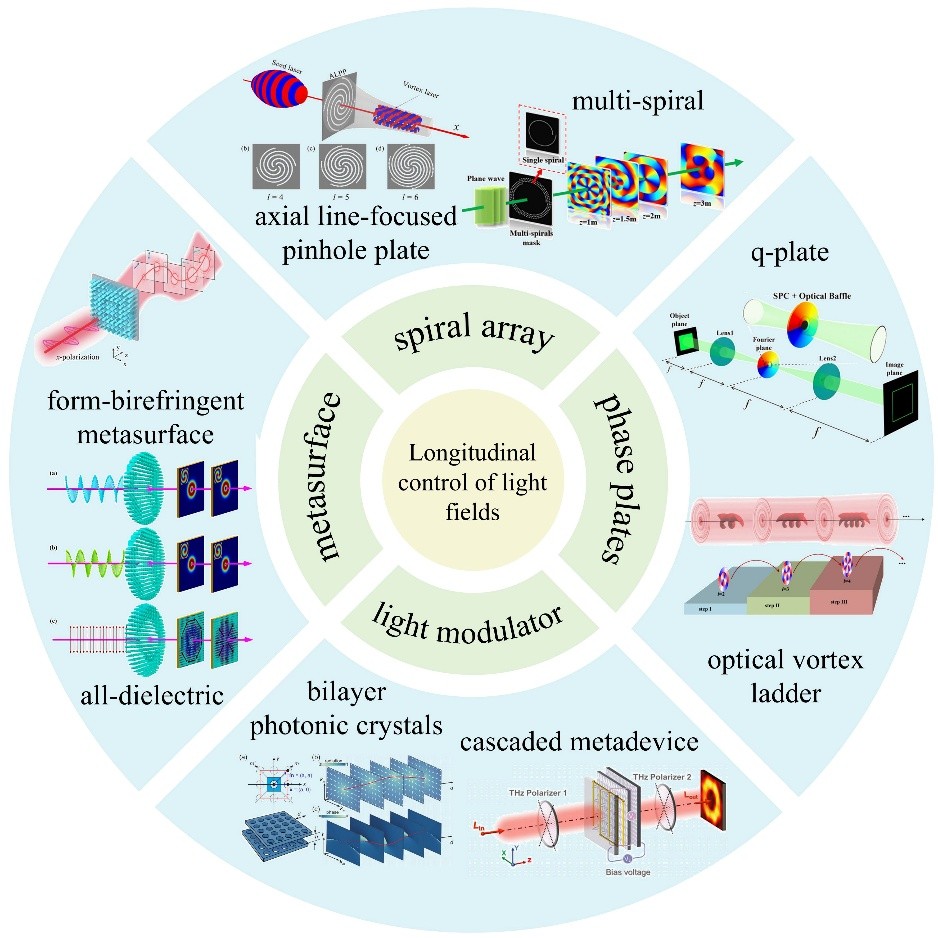
Figure 1. Core technological platforms for the longitudinal control of optical fields. Four primary device categories, each with distinct physical principles, enable the engineering of a light beam's properties along its propagation axis (z-axis). Metasurfaces[14–19,35], composed of subwavelength antennas, offer unprecedented, user-defined control over phase, amplitude, and polarization at the nanoscale, enabling extreme multi-functionality and device miniaturization. Spiral arrays[20–24,36,37], such as pinhole plates or slits, structure the light field through the fundamental principles of diffraction and interference from multiple engineered spiral sources, representing a simple and intuitive approach. Phase plates[25–29], including q-plates[38], spiral phase plates, and more complex "optical vortex ladders," introduce a static but highly engineered, spatially variant phase delay to precisely sculpt an incident wavefront with high efficiency. Light modulators[30–34,39,40], such as cascaded liquid crystal metadevices or bilayer photonic crystals, provide dynamic, real-time control over the beam's evolution, allowing for adaptive, interactive, and reconfigurable optical systems.
2. Fundamental Principles of Longitudinal Vortex Beam Manipulation
The longitudinal modulation of a vortex beam, or any light field, is fundamentally an exercise in sophisticated wave-field engineering, governed by the foundational principles of diffraction, interference, and Fourier optics. The propagation of any monochromatic light field through space, as described by the Helmholtz equation, is precisely determined by the coherent superposition of its constituent plane waves[37]. These plane waves form the basis of the field's spatial frequency spectrum, its representation in Fourier space. Therefore, by meticulously tailoring the amplitude and phase of these individual spectral components at a source plane (z=0), one can deterministically dictate the beam's complete structural evolution, as its intensity, phase, and polarization, at every subsequent point in three-dimensional space[41–43].
The intrinsic three-dimensional characteristics of vortex beams themselves provide a unique and particularly advantageous foundation for this control. Unlike simple Gaussian beams whose phase front is nearly planar near the waist, vortex beams possess a helical phase structure exp(ilφ) that is intrinsically and inextricably coupled to their propagation dynamics. This inherent link between the transverse phase profile and the longitudinal evolution gives rise to several key features that can be actively exploited[44–49] as following aspects.
Topological Stability: The central phase singularity is not merely a point of zero intensity; it is a topologically protected feature of the wavefront. The integer value l cannot change continuously and is robust against minor perturbations, meaning the vortex maintains its core structural integrity over very long propagation distances.
Annular Intensity Profile and Poynting Vector: A direct consequence of the phase singularity is the complete destructive interference at the beam's center, creating the characteristic "doughnut" intensity profile. The helical phase also imparts a transverse component to the Poynting vector, causing the energy of the beam to flow in a spiral path around the propagation axis. The size and shape of this hollow core evolve in a well-defined manner governed by diffraction.
Self-Healing Property: This remarkable property is a direct consequence of the principles of diffraction. If a portion of the vortex beam is obstructed by an opaque object, the remaining parts of the wavefront will act as a new set of Huygens sources. During subsequent propagation, the light from these sources will diffract and interfere to reconstruct the original beam structure, including the central vortex core and its topological charge. This is crucial for applications in turbulent or scattering environments like atmospheric communication or deep-tissue imaging.
Longitudinal control is achieved by actively exploiting these intrinsic properties through three primary physical mechanisms, which form the building blocks of all the technologies discussed later:
Coherent Superposition of Modes: The most direct and intuitive method for shaping the longitudinal intensity profile is the coherent superposition of multiple co-propagating spatial modes. A powerful implementation of this is the "frozen wave" concept, which typically utilizes a superposition of Bessel beams. By carefully selecting the relative amplitudes, phases, and, most critically, the distinct longitudinal wave vectors kz of these constituent beams, one can construct nearly arbitrary intensity distributions over a finite axial range[42,50,51]. The interference pattern is static in the transverse plane but evolves longitudinally in a pre-defined way. This principle is mathematically formalized by diffraction integrals, like the Rayleigh-Sommerfeld formula:
where a desired longitudinal field $E(r, \theta, z)$ is reverse-calculated to find the required complex transmission function $T(\rho, \varphi)$ at a source plane. $K(\theta) = \frac{\cos\theta_{0}}{z}$ is the tilt factor, which describes the tilt loss of the light field during propagation. $k$ is the wave vector in the propagation direction, and $R = \sqrt{z^{2} + (\rho - r)^{2}}$ represents the propagation distance from the spiral array pinhole to the observation point. This transmission function essentially encodes a complex hologram containing the necessary spatial frequency spectrum.
Wave-Vector Engineering and Caustic Theory: A more advanced and geometrically intuitive approach involves designing a phase mask that maps specific input field coordinates to desired propagation trajectories. Drawing from caustic theory, where a beam's path can be visualized as the envelope of a family of geometric rays, it becomes possible to engineer an initial phase profile that guides the beam's peak intensity along a prescribed 3D curve, such as a spiral, a parabola, or even more complex paths (Figures 2a, 2b)[13,50]. This is achieved by locally controlling the gradient of the phase, which in turn dictates the direction of the local wave vector k. This effectively couples the transverse (kx, ky) and longitudinal (kz) components to precisely steer the flow of optical energy through space[12,13]. Such phase control can be used to dynamically manipulate the propagation of terahertz beams, enabling the steering of their intensity and phase along desired paths. (Figure 2c) [40].
Spin-Orbit Coupling and Polarization Effects: The vector nature of light offers additional, powerful, and often non-intuitive degrees of freedom. The phenomenon of spin-orbit interaction (SOI) in light allows the beam's polarization state (its spin angular momentum, SAM) to be intricately linked to its spatial mode structure. The most common mechanism to achieve this is the geometric phase, also known as the Pancharatnam-Berry (PB) phase[52]. When a circularly polarized beam is passed through an anisotropic element (like a rotated nano-antenna), it acquires a phase shift equal to twice the rotation angle of the element. By creating a spatially variant pattern of these rotations, one can write any desired phase profile onto the beam, but in a spin-dependent way. This is the key to creating vector vortex beams and enabling polarization-dependent propagation dynamics, causing left- and right-circular polarizations to follow entirely different paths or to evolve their polarization state continuously along the longitudinal axis (Figures 2d‒2f)[46,47,52]. Furthermore, the Gouy phase shift—an intrinsic phase anomaly that a focused beam acquires as it passes through its focal region, which is a consequence of transverse confinement—is different for different spatial modes (e.g., Laguerre-Gaussian modes with different radial indices p). This subtle difference can be cleverly exploited to drive the longitudinal evolution of a superposition state's topological charge or polarization state.
These fundamental mechanisms, all rooted in the unique structure of vortex beams and the basic principles of wave optics, form the comprehensive toolkit that enables the advanced control techniques and technological platforms discussed in the subsequent section.
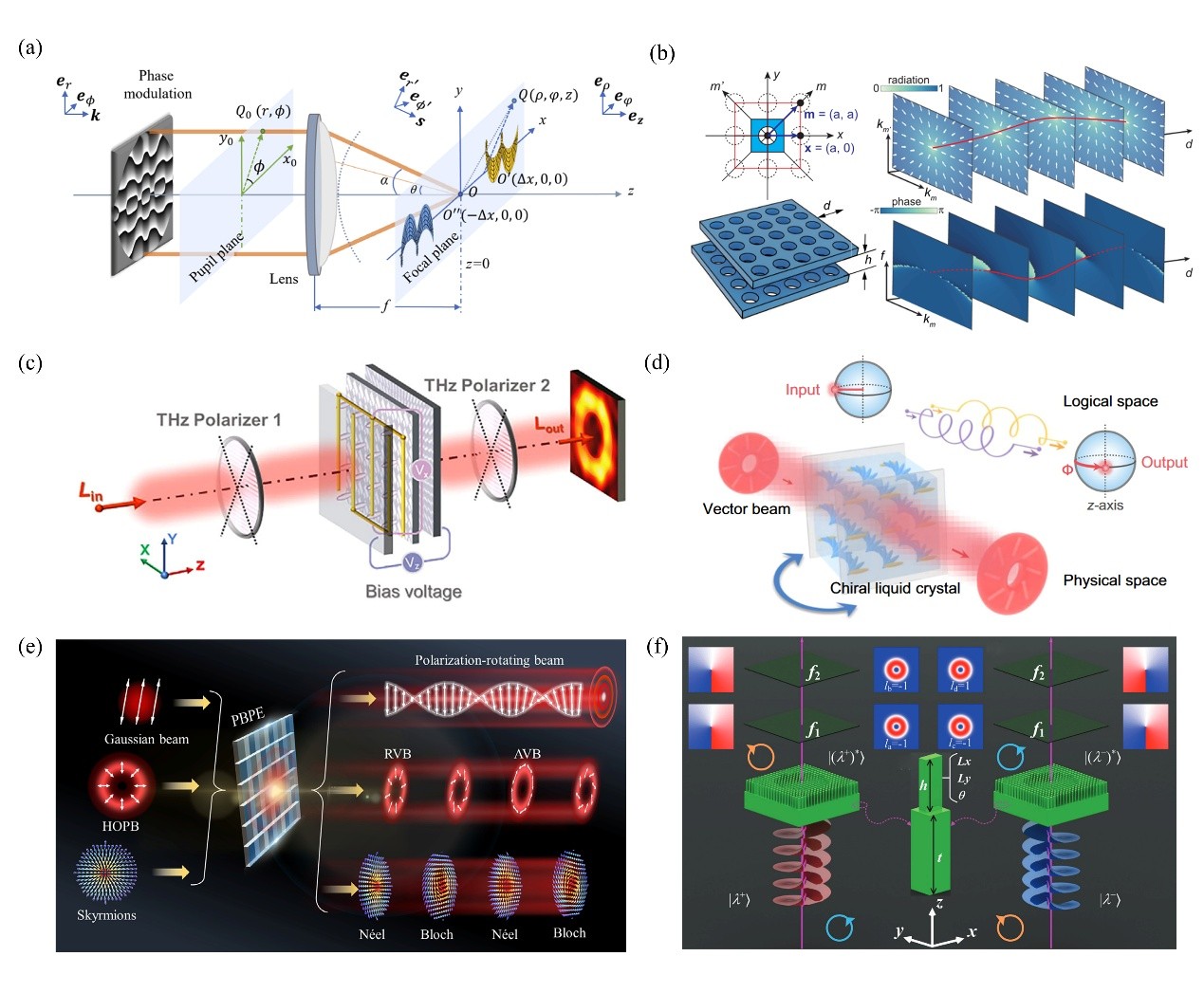
Figure 2. Fundamental physical mechanisms enabling longitudinal control. (a) Wave-vector engineering demonstrated via a phase mask at a pupil plane, followed by a focusing lens. The initial phase profile Q₀(r, φ) is computationally designed to impart a specific transverse momentum to different parts of the beam, creating an array of spatially separated focal spots along the longitudinal axis[50]. (b) An arrayed metasurface, acting as a phase-gradient hologram, imparts a locally tailored phase to an incident plane wavefront. This spatially modulates the longitudinal component of the wave-vector, kz, effectively forcing the beam's peak intensity to follow a pre-defined, arbitrary 3D trajectory[13]. (c) A cascaded terahertz (THz) device, consisting of static polarizers and a voltage-controlled liquid crystal cell, exemplifies dynamic phase and intensity control. The voltage actively tunes the birefringence of the LC layer, thus modulating the phase of the transmitted beam and allowing for active control of the structure along the z-axis[40]. (d) A vector beam propagates through a chiral liquid crystal superstructure. The inherent coupling between the beam's complex polarization structure and the medium's molecular chirality drives a deterministic evolution of its polarization and spatial mode, which can be visualized as a predictable trajectory on a logical space like the Poincaré sphere[46]. (e) A Pancharatnam-Berry phase element (PBPE) transforms various input polarization states (e.g., Gaussian, high-order Poincaré) into vector vortex beams (e.g., radial, azimuthal). The spin-orbit coupling inherent in the device causes the beam's intensity profile and polarization state to evolve periodically during propagation[52]. (f) A spin-decoupled metasurface enables independent control of the TC at two different longitudinal focal planes (f₁, f₂) for left- and right-circularly polarized light (|L⟩, |R⟩), demonstrating cooperative and decoupled structural and phase control within a single, monolithic device[47].
3. Key Technological Platforms for Longitudinal Modulation
The theoretical principles of longitudinal control are translated into practical reality using a variety of sophisticated optical devices and systems. With the continuous progress in materials, structural design, and manufacturing processes, researchers have successfully made significant breakthroughs in achieving high precision, real-time capability, and integration in longitudinal light field control. Currently, the realization of longitudinal light field control relies on a wide range of functional devices and combined systems, including additional q-plate[38], magnetized plasma polarizers[53], freeform diffractive lenses (FFDL)[54], and reflective pure-phase spatial light modulators[55]. Based on the technical principles and structural characteristics, these devices can be simplified into four core dominant and rapidly evolving platforms: metasurfaces, spiral arrays, phase plates, and LC-SLMs. Each of these technological systems has its unique features and can be adapted to meet the light field control requirements of different application scenarios.
3.1. Metasurfaces: The Apex of Subwavelength Control
Metasurfaces—planar optical elements meticulously engineered with dense arrays of subwavelength-scale nano-antennas—have emerged as a truly paradigm-shifting platform for achieving arbitrary control over light. Their defining strength lies in the ability to impart complex, spatially varying phase, amplitude, and polarization transformations to an incident wavefront, all within an ultrathin, flat form factor that is orders of magnitude thinner than conventional refractive optics. This unprecedented level of control over the fundamental properties of light makes them an exceptionally powerful and versatile tool for the longitudinal engineering of vortex beams.
A principal advantage of metasurfaces is their capacity to decouple and independently control multiple properties of light, often by designing individual "meta-atoms" that leverage multiple physical mechanisms simultaneously. For instance, by judiciously designing the shape, size, and material of a nano-antenna, one can control the propagation phase (a resonant effect that affects all light). By simultaneously controlling the in-plane orientation of that same anisotropic nano-antenna, one can independently control the geometric or PB phase, which is spin-dependent. This powerful design freedom has enabled several key functionalities for longitudinal control:
Continuous Longitudinal Polarization Transformation: This sophisticated technique leverages spin-decoupled metasurfaces to encode a z-dependent phase difference between the left- and right-circular polarization channels, typically by manipulating the focal length for each polarization. As the two spin components propagate and diffract, this accumulating phase difference between them induces a continuous evolution of the beam's overall polarization state. Seminal works have demonstrated the elegant transformation of a simple linearly polarized input beam into a radially or azimuthally polarized vector vortex beam, with the polarization state evolving smoothly and continuously along the z-axis (Figures 3a, 3f)[16–18,47,56]. Further extending this concept, holographic principles have been integrated into metasurface design to generate arbitrary and complex polarization trajectories, effectively "painting" with polarization in full 3D space[52,57].
Dynamic Longitudinal TC Control: The very same spin-decoupling mechanism can be harnessed to engineer the topological charge of a vortex beam as it propagates. By imparting opposite helical phase profiles (+l and -l) to the two orthogonal spin states, researchers have used all-dielectric metasurfaces to demonstrate the remarkable reversible evolution of a vortex beam's TC (e.g., from l=+2 to l=-2 and back again) within the terahertz band[19]. This concept can be merged with "frozen wave" techniques, where the complex hologram required to generate a superposition of co-propagating Bessel beams is encoded onto the metasurface. This allows the TC to vary in a controllable, stepwise manner in different, pre-defined spatial regions along the propagation axis (Figure 3b)[57–60].
Multi-Degree-of-Freedom Integrated Control: The ultimate promise of metasurfaces lies in their potential to integrate a multitude of optical functions into a single, monolithic element, thereby controlling several beam parameters simultaneously and independently. Recent groundbreaking demonstrations, often aided by computational inverse design, include single devices that concurrently shape a beam's propagation trajectory (e.g., forcing it to follow a prescribed S-shaped or helical curve), actively rotate its polarization state, and vary its topological charge along that very path. This achieves a truly holistic control over the light field in 3D that is impossible with conventional optics (Figures 3d, 3e) [32–36,52,60].
On-Chip Integration for Compact Systems: A burgeoning and highly promising research direction is the direct integration of metasurfaces with on-chip photonic components, such as silicon nitride (SiN) or silicon-on-insulator (SOI) waveguides. In this architecture, the metasurface functions as an ultra-efficient and highly sophisticated grating coupler, converting a confined guided mode from a photonic integrated circuit (PIC) into a complex, structured free-space field. This approach is seen as a key enabler for fully integrated LiDAR systems without moving parts, chip-scale holographic displays for augmented reality, and highly miniaturized optical systems for sensing and communication (Figure 3c)[19,33,61].
Despite their immense potential and the rapid pace of innovation, significant and persistent challenges for metasurfaces remain. The overall device efficiency, particularly for transmissive designs operating in the visible spectrum (where material losses are non-negligible) or the terahertz regime (where absorption can be high), can be a limiting factor. Furthermore, while tremendous progress is being made, creating dynamically tunable metasurfaces with the microsecond- or nanosecond-scale response times needed for high-speed applications like beam steering remains a formidable materials science and electrical engineering hurdle, with active research exploring phase-change materials, liquid crystals, and micro-electromechanical systems (MEMS) integration[56,61,62].
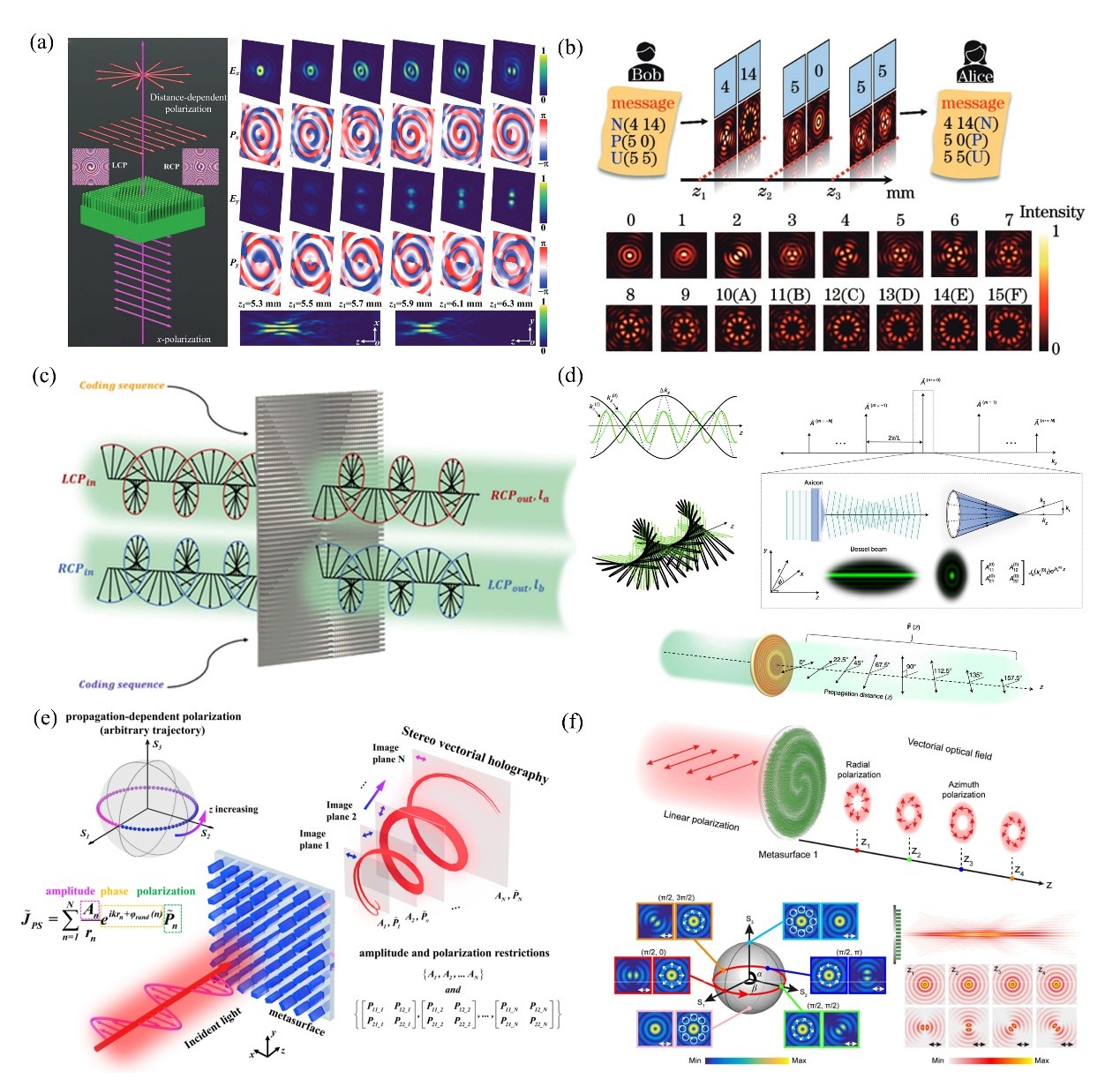
Figure 3. Metasurfaces enabling multi-dimensional and integrated longitudinal control. (a) A form-birefringent metasurface, composed of anisotropic nano-fins with varying orientation and size, is designed to engineer a continuous, diffraction-free evolution of a beam's polarization state from linear, to radial, and then to azimuthal along the propagation z-axis[47]. (b) A metasurface designed for multi-plane OAM holography encodes different, independent helical phase profiles that come into focus at several distinct longitudinal planes (z₁ to z₅). This demonstrates a capacity for 3D multiplexed information storage or multi-plane, parallel particle trapping[57]. (c) An on-chip integrated photonic system where a metasurface is fabricated directly onto a silicon nitride waveguide. This sophisticated coupler efficiently converts a confined, single-mode guided wave into a complex, structured free-space beam, essential for future applications in LiDAR or holographic projection[19]. (d) A Bessel beam, characterized by its non-diffracting and self-healing properties, is generated by an axicon-like metasurface. The beam is shown to maintain its tight, annular intensity profile over a long propagation distance, demonstrating robust longitudinal stability[52]. (e) A stereo-vectorial holographic metasurface achieves simultaneous and independent control of amplitude, phase, and polarization to project two different holographic images with fully arbitrary and distinct polarization states onto two separate longitudinal planes[60]. (f) A dielectric metasurface transforms an incident linearly polarized beam into a vector optical field. The polarization state of this output field, mapped on the surface of the Poincaré sphere, is shown to evolve continuously and predictably along the z-axis as the beam propagates[56].
3.2. Spiral Arrays: Harnessing Diffraction and Interference
Spiral arrays, which in their most fundamental form are implemented as simple amplitude or phase masks containing one or more spiral-shaped apertures, represent a foundational, elegant, and highly intuitive method for generating and controlling vortex beams. Their operation relies on the most fundamental principle of wave optics—Huygens-Fresnel diffraction. The coherent or incoherent superposition of the multitude of spherical wavelets emerging from the continuous points along the spiral arms produces a complex, dynamically evolving interference pattern that, in the far-field, consolidates into a structured vortex beam[20].
The primary and most widely explored function of a spiral array is to directly imprint a topological structure onto the light field and to govern the stability of that structure during propagation. A key finding, highlighted in recent theoretical and experimental literature, is the critical performance distinction between single-spiral and multi-spiral arrays (Figures 4a, 4c)[23,37]. It has been rigorously shown that the topological charge of a beam generated by a single Archimedean spiral slit tends to decay continuously and rapidly with propagation. This decay is often accompanied by a phenomenon known as vortex core breaking, where the central singularity splits into multiple smaller vortices, leading to significant structural instability that limits its practical use. In stark contrast, an array of multiple, rotationally symmetric spirals generates a far-field TC that decays in discrete, stable, integer steps. This stepwise evolution dramatically enhances the robustness of the OAM state, making it far more suitable for applications requiring propagation over long distances, such as free-space optical communication (Figure 4b)²⁴.
Recent research has focused on leveraging and expanding upon these fundamental diffractive properties for more advanced forms of control and new applications:
Stable Ultrashort Pulse Generation: Moving beyond the realm of continuous-wave (CW) lasers, spiral arrays have been effectively employed to structure ultrashort, femtosecond laser pulses. They have been successfully used to generate spatiotemporal optical vortices (STOVs)—exotic and fascinating wave packets that carry OAM in the space-time domain rather than the spatial domain. These experiments have demonstrated the creation of stable vortex pulses with a well-defined and controlled topological charge, opening doors for new studies in light-matter interaction (Figures 4a, 4f)[22,23,51].
Controllable Phase Singularity Dynamics: The individual phase singularities that constitute the overall vortex beam are not static; their positions evolve in a predictable manner with propagation distance. In the specific case of multi-spiral arrays (Figures 4b, 4d)[24,36], the constituent OAM magnitude undergoes a stepwise change as the beam propagates. This provides another controllable parameter or degree of freedom that can be harnessed for applications such as guiding and sorting different populations of microscopic particles based on their size or refractive index[24,37].
Generation of High-Symmetry Intensity Distributions: The geometry of the array of apertures in the near-field directly maps to the far-field intensity pattern via the Fourier transform relationship. This provides a straightforward method for generating beams with high-order rotational symmetry and polygonal shapes, where the rotational angle of the OFW’s symmetric structure is precisely tuned by adjusting the spiral arrays’ relative orientation. Such rotationally tunable symmetric beams are particularly useful for dynamic optical manipulation such as rotational trapping of micro/nanoparticles or for applications requiring real-time adjustable energy deposition profiles (Figure 4e)[21,63].
The main and enduring advantages of spiral arrays are their inherent simplicity of design and extremely low cost of fabrication, especially for amplitude masks which can be produced via standard photolithography or even 3D printing. However, they suffer from several notable and often deal-breaking drawbacks. These include intrinsically low energy efficiency (as amplitude masks by definition block a significant portion of the incident light), a limited effective distance over which control can be maintained before diffraction corrupts the structure, and an inherent lack of dynamic tunability. Future work in this specific area will likely focus on implementing these elegant spiral designs using high-efficiency all-dielectric metasurfaces to mitigate loss or integrating them into more complex photonic chip systems to overcome their static nature and add a layer of control.
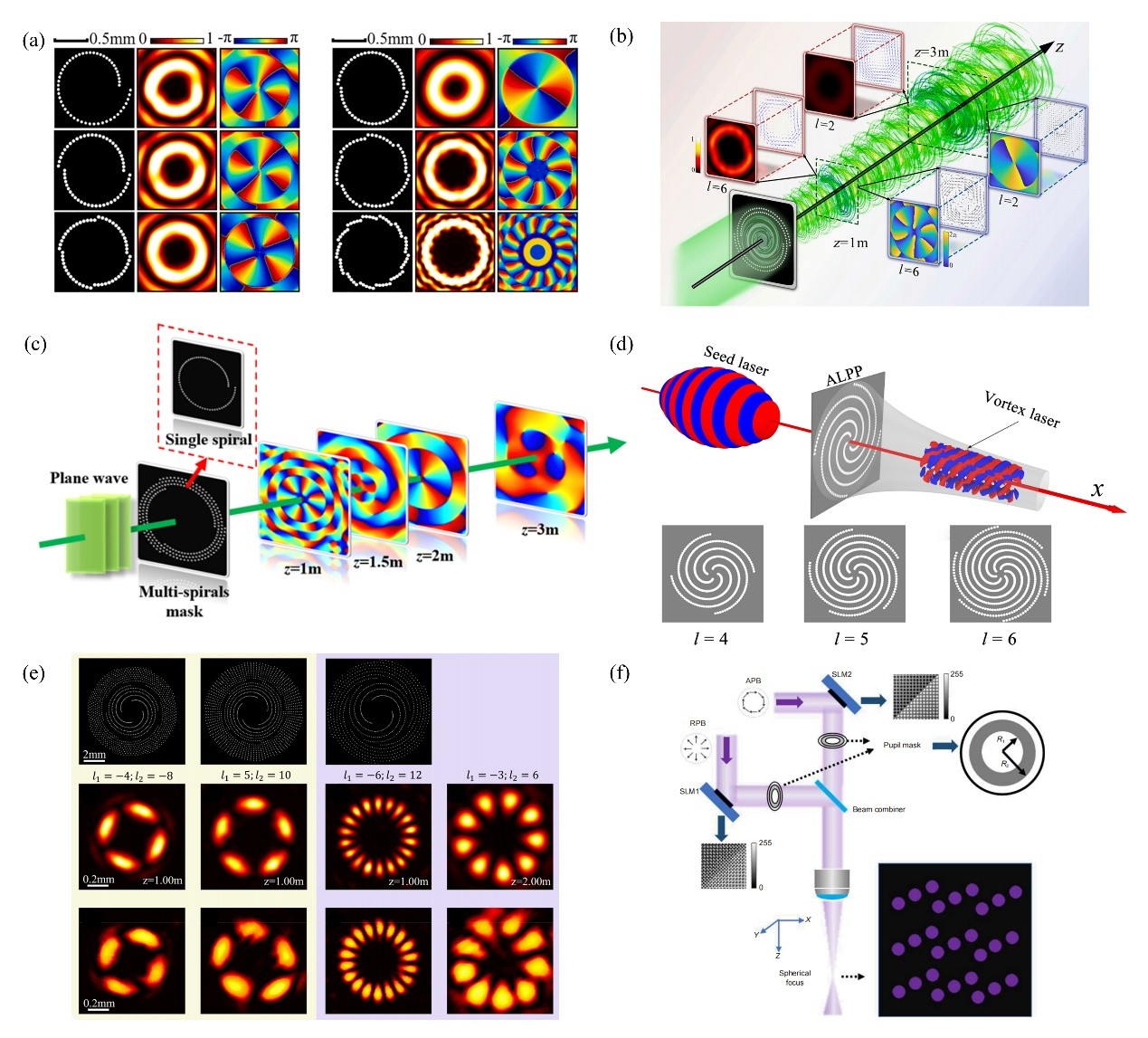
Figure 4. Longitudinal OAM control using spiral pinhole plates. (a) A direct side-by-side comparison of the intensity and phase profiles generated by a simple single-spiral plate versus a more complex multi-spiral plate. The multi-spiral structure is clearly shown to produce a more stable and well-defined central vortex core[23]. (b) Simulated trajectory of the constituent off-axis phase singularities generated by a multi-spiral plate. The overall topological charge l is shown to decay in stable, discrete, integer steps as a function of propagation distance z, a key advantage for robust OAM transmission in free space[24]. (c) A numerical propagation simulation showing the longitudinal evolution of a light field after passing through a single-spiral versus a multi-spiral mask. The simulation clearly shows that the multi-spiral design prevents the central vortex from breaking up and destabilizing during propagation, maintaining its structural integrity[37]. (d) An experimental setup using an axicon-lens-pinhole-plate (ALPP) system to generate a vortex laser. The specific spiral mask patterns, fabricated on a substrate and used to generate different topological charges[36]. (e) Multi-dimensional visualization of the generated optical Ferris wheel (OFW) evolution, including its 2D transverse intensity profile and 3D intensity isosurface. The images clearly show the controlled variation of the OFW’s complex structure along the z-axis[63]. (f) A sophisticated experimental setup for the ultrafast measurement and control of OAM states generated by a spiral plate. The setup involves advanced spectral characterization and a transient grating pump-probe scheme to analyze the complex optical dynamics on a femtosecond timescale[51].
3.3. Phase Plates: High-Fidelity Static Wavefront Sculpting
Phase plates are a well-established and foundational class of transmissive or reflective optical components designed to impart a precisely engineered, spatially varying phase delay to an incident wavefront. In the specific context of vortex beam control, the most common and well-known variant is the spiral phase plate (SPP), which is a transparent plate whose physical thickness increases azimuthally in a spiral fashion to introduce a phase of exp(ilφ). However, by moving beyond this simple canonical form and engineering far more complex, non-trivial phase distributions, these static optical elements can be used to exert surprisingly sophisticated and robust control over a beam's longitudinal evolution[3,64–66].
The advanced control mechanisms enabled by these custom-designed, static phase plates are diverse and powerful, including:
Engineered Longitudinal TC Evolution: While a simple SPP generates a vortex with a fixed topological charge, more advanced and intricate designs enable its variation along the propagation axis. One powerful technique involves designing a phase plate that generates a superposition of multiple co-axial Laguerre-Gaussian (LG) modes, all with the same azimuthal index l but with different radial indices p. Due to the differing Gouy phase shifts experienced by each of these constituent modes as they propagate through a focus, their relative phases evolve continuously. This causes the effective TC of the superposed beam to change along the z-axis, often in discrete steps. This has been used to create a so-called "optical vortex ladder," where the TC appears to climb from one integer value to another (Figures 5a, 5f)[25,26,67]. In a related vein, phase plates designed to generate fractional-TC vortices can be used to create intricate optical vortex knots and chains whose very topology dynamically transforms during propagation[58].
Coupled Longitudinal Intensity and Focus Control: By mathematically combining a spiral phase profile with the phase profile of a diffractive lens (such as a Fresnel zone plate), one can create multi-functional phase plates known as "lens-icons" that simultaneously focus light and impart OAM. This has been exploited in the field of fiber optics, where such complex patterns are etched directly onto a fiber tip to achieve super-variable focusing and OAM generation in a compact package (Figure 5d)[68]. In free-space systems, this principle is used for generating ordered, three-dimensional arrays of individual focal spots, where each focus can be independently assigned a different topological charge[3,54,69–71].
Coupled Polarization and Magnetization Control: When phase plates are combined with other elements, their utility expands further. In conjunction with polarization-sensitive elements like q-plates, they enable independent and decoupled control over a beam's longitudinal amplitude, phase, and focal depth (Figure 5b)[38,72]. An even more exotic and cutting-edge application lies in the field of magneto-optics. Here, the structured phase from an SPP, when imprinted on a high-intensity femtosecond laser pulse, can be used to all-optically write complex 3D longitudinal magnetization textures into a suitable magnetic material via the inverse Faraday effect. This opens the door for ultrafast, terabyte-density, all-optical magnetic data storage (Figure 5c)[27,65,66].
Recent advancements in this area have focused heavily on miniaturization and on overcoming the inherently static nature of traditional phase plates. By integrating customized phase patterns directly onto the facets of optical fibers, researchers have created extremely compact, robust, and permanently alignment-free devices suitable for demanding applications like medical endoscopy and telecommunications[3]. The function of dynamic control, however, has largely been ceded to LC-SLMs, which can be thought of as fully programmable, real-time phase plates. They can display computer-generated holograms that digitally combine the functions of SPPs, lenses, axicons, and other elements, offering flexibility that a static plate cannot (Figure 5e)[55,73].
However, significant fabrication challenges persist for static phase plates. The manufacturing of high-quality, high-TC (l > 10) SPPs with nanometer-scale surface precision remains difficult and expensive, as even small fabrication errors can lead to significant vortex mode instability and performance degradation. Metal-based plates, while easier to make, suffer from high ohmic absorption and thus low transmission efficiency. Multi-level dielectric phase plates, which approximate a continuous profile with discrete steps, are more efficient but are complex and costly to manufacture. Future progress will likely involve leveraging machine learning and deep learning to discover and optimize novel, high-performance phase designs, and using advanced additive manufacturing techniques like two-photon polymerization to create arbitrary, 3D-printed, multi-functional phase plates for next-generation optical systems.
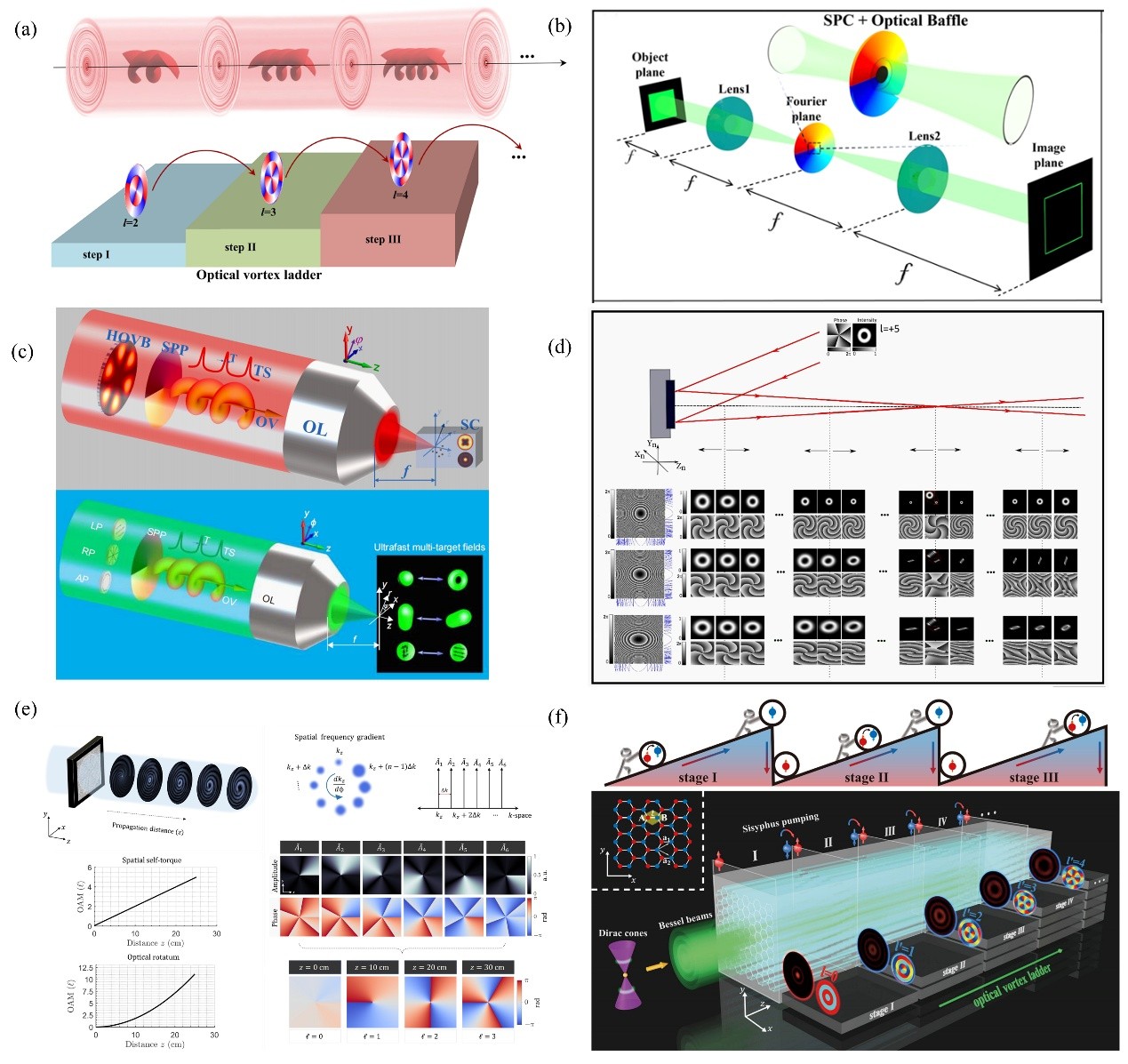
Figure 5. Engineered phase plates for structuring light fields in the longitudinal dimension. (a) A phase-plate-based optical system generating an "optical vortex ladder." The effective topological charge of the beam is engineered to evolve in discrete integer steps (e.g., from l=2 to l=4) as it propagates, a result of the mode-dependent Gouy phase shift[26]. (b) A white-light spiral phase contrast imaging system. An object is imaged through a 4f Fourier-plane system containing a spiral phase component (SPC). This component acts as a spatial filter that converts invisible phase variations in the object into visible intensity variations in the final image[38]. (c) A high-order vortex beam generated with a high-quality spiral phase plate (SPP), with its complex fine-grained structure analyzed post tight focusing by a high-numerical-aperture objective lens (OL); a cutting-edge setup for all-optical writing of ultra-long 3D longitudinal magnetization textures into a magneto-optical medium is also shown, utilizing a focused azimuthally polarized circular Airy vortex beam via complex phase modulation[65,66]. (d) A system for generating multi-TC light fields, showing the intricate, computer-generated phase masks required and the resulting intensity and phase profiles measured at different propagation distances, demonstrating longitudinal evolution[68]. (e) Calculated longitudinal evolution of a beam's spatial self-torque, optical rotation, and its amplitude/phase profiles at different z positions after being modulated by a custom-designed, non-trivial phase plate[55]. (f) A schematic explaining the Sisyphus pumping mechanism in a photonic lattice, the physical basis for the vortex ladder. The carefully designed interplay between discrete mode coupling between lattice sites and the continuous Gouy phase shift drives a stepwise, unidirectional increase in OAM[67].
3.4. Liquid Crystal Spatial Light Modulators (LC-SLMs): The Power of Real-Time Reconfigurability
Liquid Crystal Spatial Light Modulators (LC-SLMs) are electrically addressable, pixelated devices that enable real-time, dynamic, and high-resolution control over a light field's phase, amplitude, or polarization state. This unparalleled programmability and reconfigurability make them an exceptionally versatile and indispensable tool for longitudinal light field engineering. They allow researchers to generate, modify, and switch between different complex optical functions entirely on the fly by simply changing the image displayed on a computer screen, all without any moving parts[30,31].
The core control mechanism of a standard LC-SLM relies on applying a variable voltage to a large array (often millions) of transparent indium tin oxide (ITO) electrodes, where each electrode controls a single liquid crystal cell or "pixel". The applied electric field reorients the long, rod-like birefringent LC molecules within the cell, thus locally modifying the effective refractive index experienced by light passing through it. By displaying a 2D map of voltages, typically encoded as an 8-bit grayscale image, the device acts as a high-fidelity, programmable phase mask, enabling several advanced and dynamic control schemes:
Dynamic Phase and Holographic Modulation: By displaying a computer-generated hologram (CGH) on a phase-only SLM, the device functions as a completely reconfigurable diffractive optical element (DOE). This is by far the most common and flexible method for generating arbitrary and complex vortex beams. It is routinely used to create dynamic arrays of optical traps, to project foci with different topological charges onto different longitudinal planes, and to generate self-accelerating or self-rotating beams that follow arbitrary, pre-defined 3D trajectories (Figures 6c, 6d)[29,39,74,75]. The ability to update the hologram at video rates (typically 60-120 Hz) is crucial for interactive applications like real-time particle sorting.
Chiral and Helical Superstructures for Advanced Control: Beyond standard nematic LCs, more advanced devices utilize special chiral liquid crystals that self-assemble into helical superstructures, effectively forming a tunable, one-dimensional photonic crystal. The pitch of this molecular helix can be tuned with an external stimulus like an electric field or temperature. This allows for dynamic control over the device's optical rotatory dispersion and its geometric phase response, enabling complex holographic effects that evolve dynamically with both wavelength and propagation distance, adding yet another layer of controllable complexity (Figures 6a, 6b)[31,76].
Integrated and Hybrid Metadevices: A powerful and recent trend is the synergistic combination of LC-SLMs with other passive optical technologies, most notably metasurfaces. In these hybrid devices, a passive metasurface provides a static, highly complex optical transformation (e.g., very high-resolution or polarization-dependent phase control that is difficult for an SLM alone), while an active LC overlayer provides the crucial element of dynamic tunability. This approach has been successfully used to create active terahertz metadevices that allow for real-time electrical switching of vortex beam properties and polarization states, effectively combining the best of both worlds (Figure 6e)[40,77].
The primary and undisputed advantage of LC-SLMs is their real-time programmability, a feature that is absolutely indispensable for applications in adaptive optics (e.g., correcting for atmospheric turbulence), dynamic and interactive optical trapping, and reconfigurable optical communication networks. However, they are not a perfect solution and have inherent limitations. Their pixelated structure introduces unwanted diffraction orders due to the grid-like pattern, which can lower overall efficiency and introduce noise into the system. Their response time is typically limited by the viscosity of the liquid crystals to the tens of milliseconds range, which is too slow for some ultrafast switching applications. Finally, their power handling capacity is significantly lower than that of static dielectric optics, as high-intensity laser light can damage the liquid crystal material, limiting their use in high-power laser systems. Future research will intensely focus on developing faster and more robust liquid crystal materials, increasing device resolution and fill factor (the percentage of active area), and achieving deeper integration with on-chip photonic systems to broaden their applicability.
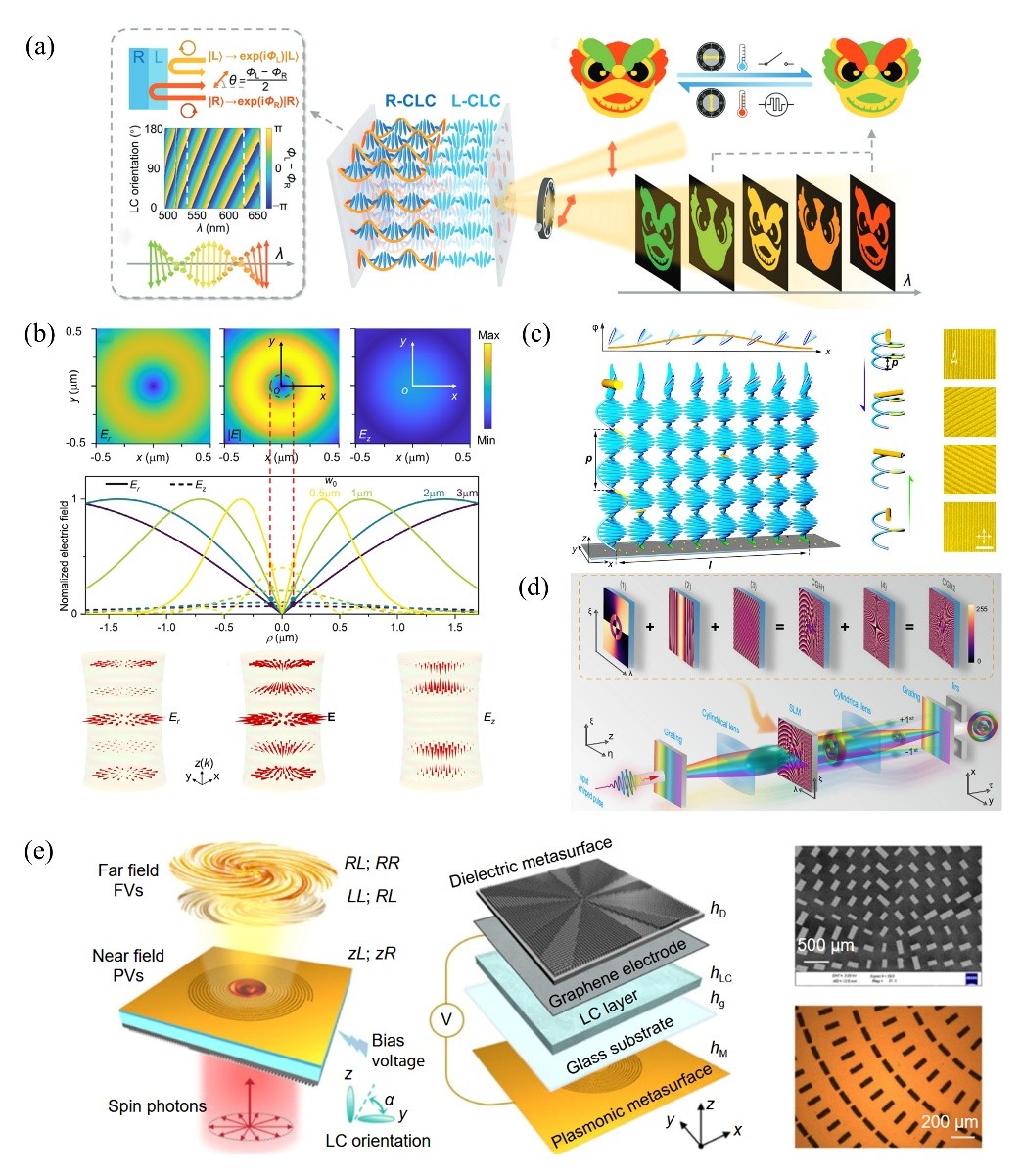
Figure 6. LC-SLMs for dynamic and reconfigurable longitudinal control. (a) A bi-chiral liquid crystal device that produces different, wavelength-dependent longitudinal holographic image evolutions. This multi-dimensional control is enabled by the voltage-controlled orientation of the helical molecular superstructures within the LC material[31]. (b) A numerical simulation characterizing the electric field control within a single pixel of an LC device. It shows the electric potential distribution, the resulting field strength, and the subsequent reorientation of the anisotropic liquid crystal molecules that underpins the device's phase-modulating function[76]. (c) A programmable liquid crystal array generates a self-propelling beam whose complex structure dynamically evolves along the z-axis. This creates intricate 3D optical patterns that can function as dynamic optical actuators for moving or rotating micro-particles[74]. (d) A composite optical system that combines multiple diffractive elements, including a high-resolution SLM, to generate a 3D array of high-order Poincaré sphere beams, with each beam located at a different, well-defined longitudinal plane[75]. (e) A hybrid metadevice that synergistically integrates a passive dielectric metasurface with an active liquid crystal layer and patterned graphene electrodes. This novel architecture enables dynamic electrical control over both near-field and far-field polarization vortex states, combining the static complexity of metasurfaces with the active tunability of liquid crystals[77].
4. Outlook and Perspective
The longitudinal control of vortex light fields has demonstrably matured from a subject of fundamental scientific inquiry and laboratory curiosity into a powerful and increasingly practical subfield of modern photonics. As this review has systematically shown, the parallel and often synergistic development of advanced technological platforms such as metasurfaces, LC-SLMs, and novel phase plates has enabled an unprecedented and previously unimaginable level of control over the propagation dynamics of structured light in all three dimensions. Despite this impressive and rapid progress, several exciting, formidable challenges and profound opportunities lie ahead. These will undoubtedly define the future trajectory of the field and lead to the next generation of optical technologies.
Looking forward, we foresee progress being driven by three key interdisciplinary and interconnected themes. First is the intelligent design and multi-physics integration. The next generation of control devices will move decisively beyond purely optical design considerations and embrace a more holistic, multi-physics approach. The synergistic integration of active materials—such as non-volatile phase-change materials (e.g., GST), transparent conductive oxides (e.g., graphene, ITO for electrical gating), and MEMS for physical reconfiguration—with metasurface and liquid crystal platforms will enable devices that are non-volatile (holding their state without power), faster, and more energy-efficient. Furthermore, the use of powerful computational tools, particularly deep learning and inverse design algorithms, will become standard practice, moving away from simple, intuitive designs. In an inverse design approach, instead of a human guessing a structure, an algorithm starts with the desired output (e.g., a beam that focuses at three specific points with three different TCs) and works backward to compute the required, often non-intuitive, nanostructure to achieve it. This will allow for the automated discovery of highly complex structures capable of performing multiple, previously intractable optical functions simultaneously.
Second is pushing the frontiers from spatial to spatiotemporal control. To date, the vast majority of research in this area, as reviewed here, has focused on structuring the spatial envelope of light. The next grand frontier, a truly fourth dimension of control, is the achievement of full, four-dimensional spatiotemporal control of vortex beams. This involves structuring the light field not just in (x, y, z) but also in time (t) on femtosecond to attosecond scales. The generation, manipulation, and detection of exotic wavepackets like spatiotemporal optical vortices (STOVs), "flying doughnut" pulses, and other custom light bullets will unlock entirely new physical regimes and applications. These range from ultrafast information processing and fundamentally secure communication protocols to novel light-matter interaction dynamics for probing material properties on their natural timescales, and even advanced particle acceleration schemes[53,78,79].
Third is transitioning from classical control to foundational quantum applications. While many of the applications discussed are classical in nature, the ability to precisely control OAM modes in 3D has profound and direct implications for the rapidly growing field of quantum science and technology. Longitudinally structured vortex beams, with their robust and dynamically evolving topological properties, can serve as high-dimensional quantum information carriers, or "qudits." A single photon can be prepared in a superposition of many OAM states (l=...-2, -1, 0, 1, 2...), creating a d-dimensional state space that is vastly larger than a qubit's two dimensions. This dramatically increases the information capacity and noise resilience of quantum communication protocols. The development of integrated, reconfigurable, and scalable devices for the high-fidelity sorting, manipulating, and entangling of these complex OAM states will be a crucial enabling step for realizing practical quantum information systems, distributed quantum computing networks, and novel quantum sensing modalities that leverage OAM's rotational sensitivity[75,80].
In summary, the longitudinal manipulation of vortex beams is a field exceptionally rich with scientific potential and tangible technological promise. By vigorously addressing the persistent and difficult challenges of device integration, dynamic control speed, and overall energy efficiency, and by wholeheartedly embracing interdisciplinary approaches that merge photonics with materials science, artificial intelligence, and quantum physics, this field is poised to deliver a new generation of transformative technologies that will impact both fundamental science and practical application.
Conflicts of Interest
The author Li Ma is an editor of X-Disciplinarity but was not involved in the peer review or decision-making process for this article.
Funding
No funding.
Author Contributions
All authors read and approved the final manuscript.
Acknowledgements
This study is grateful to all the authors for their full contributions.
Reference
[1] A. Mair, A. Vaziri, G. Weihs, A. Zeilinger. “Entanglement of the orbital angular momentum states of photons.” Nature 2001, 412, 6844, 313–316.
[2] K. S. Youngworth, T. G. Brown. “Focusing of high numerical aperture cylindrical-vector beams.” Opt. Express 2000, 7, 2, 77.
[3] J. Yu, C. Fu, Z. Bai, Y. Wang. “Super-Variable Focusing Vortex Beam Generators Based on Spiral Zone Plate Etched on Optical Fiber Facet.” J. Light. Technol. 2021, 39, 5, 1416–1422.
[4] S. Fu, Y. Zhai, H. Zhou, J. Zhang, T. Wang, X. Liu, C. Gao. “Experimental Demonstration of Free-Space Multi-State Orbital Angular Momentum Shift Keying.” Opt. Express 2019, 27, 23, 33111.
[5] Y. Yang, Q. Zhao, L. Liu, Y. Liu, C. Rosales-Guzmán, C. Qiu. “Manipulation of Orbital-Angular-Momentum Spectrum Using Pinhole Plates.” Phys. Rev. Appl. 2019, 12, 6, 064007.
[6] S. M. Barnett, L. Allen. “Orbital angular momentum and nonparaxial light beams.” Opt. Commun. 1994, 110, 5–6, 670–678.
[7] L. Allen, M. W. Beijersbergen, R. J. C. Spreeuw, J. P. Woerdman. “Orbital angular momentum of light and the transformation of Laguerre-Gaussian laser modes.” Phys. Rev. A 1992, 45, 11, 8185–8189.
[8] J. Wang, J.-Y. Yang, I. M. Fazal, N. Ahmed, Y. Yan, H. Huang, Y. Ren, Y. Yue, S. Dolinar, M. Tur, A. E. Willner. “Terabit Free-Space Data Transmission Employing Orbital Angular Momentum Multiplexing.” Nat. Photonics 2012, 6, 7, 488–496.
[9] N. Yu, P. Genevet, M. A. Kats, F. Aieta, J.-P. Tetienne, F. Capasso, Z. Gaburro. “Light Propagation with Phase Discontinuities: Generalized Laws of Reflection and Refraction.” Science 2011, 334, 6054, 333–337.
[10] M. Padgett, R. Bowman. “Tweezers with a twist.” Nat. Photonics 2011, 5, 6, 343–348.
[11] M. Miranda, M. Kotur, P. Rudawski, C. Guo, A. Harth, A. L’Huillier, C. L. Arnold. “Spatiotemporal Characterization of Ultrashort Optical Vortex Pulses.” J. Mod. Opt. 2017, 64, sup4, S1–S6.
[12] L. Ma, P. Zhang, Z. Li, C. Liu, X. Li, Y. Zhang, R. Zhang, C. Cheng. “Spatiotemporal Evolutions of Ultrashort Vortex Pulses Generated by Spiral Multi-Pinhole Plate.” Opt. Express 2017, 25, 24, 29864.
[13] L. Huang, X. Chen, H. Mühlenbernd, H. Zhang, S. Chen, B. Bai, Q. Tan, G. Jin, K.-W. Cheah, C.-W. Qiu, J. Li, T. Zentgraf, S. Zhang. “Three-Dimensional Optical Holography Using a Plasmonic Metasurface.” Nat. Commun. 2013, 4, 1, 2808.
[14] Q. Jiang, H. Xiang, D. Han. “Generation of Bessel Beams with Tunable Longitudinal Electric and Magnetic Fields Using an All-Dielectric Metasurface.” Opt. Lett. 2023, 48, 4, 920.
[15] T. Nan, H. Zhao, J. Guo, X. Wang, H. Tian, Y. Zhang. “Generation of Structured Light Beams with Polarization Variation along Arbitrary Spatial Trajectories Using Tri-Layer Metasurfaces.” Opto-Electron. Sci. 2024, 3, 5, 230052–230052.
[16] C. Zheng, J. Li, J. Liu, J. Li, Z. Yue, H. Li, F. Yang, Y. Zhang, Y. Zhang, J. Yao. “Creating Longitudinally Varying Vector Vortex Beams with an All‐Dielectric Metasurface.” Laser Photonics Rev. 2022, 16, 10, 2200236.
[17] H. Ahmed, M. A. Ansari, R. Yan, X. Chen. “Customizing Multicolored Orbital Angular Momentum Combs.” Nano Lett. 2025, 25, 13, 5366–5374.
[18] J. Yang, R. Zhao, Y. Li, H. Xiong, Y. Li, X. Li, J. Li, Y. Wang, L. Huang. “Generation of the Bessel Beam of Longitudinally Varied Polarization with Dielectric Metasurfaces.” Adv. Opt. Mater. 2023, 11, 10, 2202896.
[19] P. Zhang, Q. Wang, T. Zhao, B. Fang, C. Li, L. Wang, Z. Hong, X. Jing. “Generation of Vortex Beams via All-Dielectric Spin-Multiplexed Coding Metamaterials.” J. Light. Technol. 2023, 41, 23, 7148–7154.
[20] X. Liu, N. Zhang, Q. Cao, J. Liu, C. Liang, Q. Zhan, Y. Cai. “Dynamics of Photonic Toroidal Vortices Mediated by Orbital Angular Momenta.” Sci. Adv. 2025. 11, 23, eabn8763.
[21] Y. Liu, C. Zhou, K. Guo, Z. Wei, H. Liu. “Generation and Measurement of Irregular Polygonal Perfect Vortex Optical Beam Based on All-Dielectric Geometric Metasurface.” Opt. Express 2023, 31, 10, 16192.
[22] L. Ma, C. Chen, Z. Zhan, Q. Dong, C. Cheng, C. Liu. “Generation of Spatiotemporal Optical Vortices in Ultrashort Laser Pulses Using Rotationally Interleaved Multispirals.” Opt. Express 2022, 30, 26, 47287.
[23] L. Ma, Z. Zhan, C. Chen, C. Liu, C. Cheng. “Generation of Ultrashort Vortex Pulses by Spiral Array.” Opt. Laser Technol. 2022, 155, 108354.
[24] L. Ma, Y. Zhang, Y. Wang, F. Azeem, Y. Gao. “Longitudinal Dynamics of Optical Vortices Based on Multi-Spiral Arrays.” Chaos Solitons Fractals 2025, 201, 117385.
[25] Z. Zhou, X. Liu, Z. Nie, H. Lin, C. Guo, B. Jia. “All‐Optical Generation of Multifunctional and Tunable Longitudinal Magnetization Textures.” Ann. Phys. 2022, 534, 8, 2200127.
[26] X. Fan, X. Wu, L. Zhou, X. Bi, J. Du, B. Wei, Y. Zhang, S. Liu, J. Zhao, P. Li. “Configurable Optical Vortex Ladder in Free Space.” APL Photonics 2025, 10, 3, 036107.
[27] Z. Nie, Z. Ning, X. Liu, Y. Zhang, H. Wang, E. Cao, W. Yan. “Creating Multiple Ultra-Long Longitudinal Magnetization Textures by Strongly Focusing Azimuthally Polarized Circular Airy Vortex Beams.” Opt. Express 2023, 31, 12, 19089.
[28] M. A. Porras. “Exploding Paraxial Beams, Vortex Beams, and Cylindrical Beams of Light with Finite Power in Linear Media, and Their Enhanced Longitudinal Field.” Phys. Rev. A. 2021, 103, 3, 033506.
[29] Z. Zhang, X. Liu, H. Wang, C. Liang, Y. Cai, J. Zeng. “Flexible Optical Trapping and Manipulating Rayleigh Particles via the Cross-Phase Modulated Partially Coherent Vortex Beams.” Opt. Express 2024, 32, 20, 35051.
[30] H. Qin, Z. Su, M. Liu, Y. Zeng, M.-C. Tang, M. Li, Y. Shi, W. Huang, C.-W. Qiu, Q. Song. “Arbitrarily Polarized Bound States in the Continuum with Twisted Photonic Crystal Slabs.” Light Sci. Appl. 2023, 12, 1, 66.
[31] S. Liu, L. Zhu, Y. Zhang, W. Chen, D. Zhu, P. Chen, Y. Lu. “Bi‐Chiral Nanostructures Featuring Dynamic Optical Rotatory Dispersion for Polychromatic Light Multiplexing.” Adv. Mater. 2023, 35, 33, 2301714.
[32] S. Qi, S. Liu, L. Han, B. Wei, P. Li, J. Zhong, X. Guo, J. Zhao. “Dynamically Measuring the Holo-Information of Light Fields in Three-Dimensional Space Using a Periodic Polarization-Structured Light.” Sci. China Phys. Mech. Astron. 2021, 64, 6, 264211.
[33] C. Yang, A. K. Sahoo, Y. Shen, P. Song, C. Lee. “Full‐Spectrum Tunable and Handedness Invertible Geometric Phase Elements in Nanomotor‐based Spiral Superstructures.” Adv. Opt. Mater. 2025, 13, 20, 2500590.
[34] Q. Wang, C. Tu, J.-H. Zhao, X. Zhang, Z.-Q. Wu, M.-Y. Wang, Y. Li, H.-T. Wang. “Customization and Information Encoding of Longitudinally Polarized Light Fields.” Adv. Photonics Res. 2023, 4, 12, 2300236.
[35] J. Yang, R. Zhao, Y. Li, C. Tian, X. Ji, X. Li, J. Li, Y. Wang, L. Huang. “Transformation of Longitudinally Customizable Curved Vector Vortex Beams Using Dielectric Metasurface.” Laser Photonics Rev. 2024, 18, 10, 2400226.
[36] H. Zhang, H. Huang, L. Zhang, J. Wang, C. Li, W. Tang, T. Yu. “Ultra-Intense High-Order-Mode Vortex Laser Generation via Axial Line-Focused Pinhole Plates.” Opt. Express 2025, 33, 6, 13921.
[37] J. Wang, X. Yang, P. Li, L. Ma. “Longitudinal Evolution of Phase Vortices Generated by Rotationally Interleaved Multi-Spiral.” Opt. Express 2024, 32, 9, 15433.
[38] R. Deng, H. Yang, S. Feng, K. Tu, Y. Zhong, J. Tang, H. Zheng, J. Yu, Z. Chen, W. Zhu. “White-Light Spiral Phase Contrast Imaging.” Opt. Express 2025, 33, 15, 31244.
[39] X. Ni, Y. Liu, B. Lou, M. Zhang, E. L. Hu, S. Fan, E. Mazur, H. Tang. “Three-Dimensional Reconfigurable Optical Singularities in Bilayer Photonic Crystals.” Phys. Rev. Lett. 2024, 132, 7, 073804.
[40] H. Zhao, F. Fan, Y. Wang, J. Liu, Y. Ji, J. Cheng, S. Chang. “Vortex‐Vector Beam Conversion and Chiral Field Manipulation Based on Terahertz Liquid Crystal Cascaded Metadevice.” Laser Photonics Rev. 2024, 18, 10, 2400442.
[41] V. Aita, D. J. Roth, A. Zaleska, A. V. Krasavin, L. H. Nicholls, M. Shevchenko, F. J. Rodríguez-Fortuño, A. V. Zayats. “Longitudinal Field Controls Vector Vortex Beams in Anisotropic Epsilon-near-Zero Metamaterials.” Nat. Commun. 2025, 16, 1, 3807.
[42] C. Liu, Y. Lan, J. Han, H. Zhang. “Longitudinal Encoding of Focused Vector Vortex Beams Empowered by Silicon Metasurfaces.” Opt. Laser Technol. 2024, 176, 110897.
[43] S. Liu, X. Zhang, L. Ma. “Longitudinal Manipulation of Optical Lattices Based on Six-Aperture Spiral Array.” X-Discip. 2025, 1, 4, 4.
[44] X. Liu, Y. Peng, S. Tu, J. Guan, C. Kuang, X. Liu, X. Hao. “Generation of Arbitrary Longitudinal Polarization Vortices by Pupil Function Manipulation.” Adv. Photonics Res. 2021, 2, 1, 2000087.
[45] L. S. J., Z. Y. H., Z. L., C. P., L. Y. Q. “Liquid Crystal Spiral Dammann Zone Plates Based on Photoalignment Technology.” Chin. J. Liq. Cryst. Disp. 2023, 38, 1, 1–9.
[46] Y.-H. Zhang, S.-J. Liu, P. Chen, D. Zhu, W. Chen, S.-J. Ge, Y. Wang, Z.-F. Zhang, Y.-Q. Lu. “Logical Rotation of Non-Separable States via Uniformly Self-Assembled Chiral Superstructures.” Nat. Commun. 2024, 15, 1, 1108.
[47] H. Li, S. Duan, C. Zheng, J. Li, H. Xu, C. Song, F. Yang, Y. Liu, W. Shi, Y. Zhang, Y. Shen, J. Yao. “Longitudinal Manipulation of Scalar to Vector Vortex Beams Evolution Empowered by All‐Silicon Metasurfaces.” Adv. Opt. Mater. 2023, 11, 22, 2301368.
[48] T. Ma, K. Zhao, M. Gu, H. Zhou, C. Liu, C. Cheng, Q. Dong, L. Ma. “Longitudinal Super-Resolution Spherical Multi-Focus Array Based on Column Vector Light Modulation.” Nanomaterials 2025, 15, 5, 324.
[49] X. He, H. Bao, F. Zhang, T. Kang, M. Pu, Y. Chen, Y. Guo, J. Gong, M. Xu, X. Luo. “Longitudinally Continuous Varying High-Order Cylindrical Vector Fields Enabled by Spin-Decoupled Metasurfaces.” Nanophotonics 2024, 13, 9, 1657–1664.
[50] X. Ying, G. Rui, S. Zou, B. Gu, Q. Zhan, Y. Cui. “Synthesis of Multiple Longitudinal Polarization Vortex Structures and Its Application in Sorting Chiral Nanoparticles.” Opt. Express 2021, 29, 12, 19001.
[51] O. Atalar, R. Van Laer, A. H. Safavi-Naeini, A. Arbabian. “Longitudinal Super-Resolution Spherical Multi-Focus Array Based on Column Vector Light Modulation.” Nat. Commun. 2022, 13, 1, 1526.
[52] Y. Zou, Y. Li, J. Yan, H. Liu, Y. Zhang, Y. Zhang, D. Wen, P. Li, B. Wei, J. Zhao, S. Liu. “On‐Demand Longitudinal Transformations of Light Beams via an Amplitude‐Phase‐Decoupled Pancharatnam‐Berry Phase Element.” Laser Photonics Rev. 2025, e02167.
[53] J. Cheng, Q. Jia, W. Liu, Q. Huang, J. Zheng. “Generating Intense Cylindrical Vector Vortex Beams through the Q-Plate-like Magnetized Plasma.” Opt. Express 2025, 33, 10, 20360.
[54] E. Ipus, L. Ordóñez, A. León-Ramírez, O. Mendoza-Yero. “Tunable Focused Vortex Beams Assisted by Freeform Diffractive Optics.” Opt. Laser Technol. 2022, 153, 108324.
[55] A. H. Dorrah, A. Palmieri, L. Li, F. Capasso. “Rotatum of Light.” Sci. Adv. 2025, 11, 15, eadr9092.
[56] P. Zhou, L. Chen, H. Ye, Y. Liu, S. Deng. “Metasurface-Assisted Generation and Manipulation of Vectorial Optical Fields.” In Nano-optoelectronics and Micro/Nano-photonics XI; Yu, S., Z. Zhou, K. Wada, Eds.; SPIE: Beijing, China, 2025; p 36.
[57] X. H. Fan, X. G. Wu, L. Zhou, S. Liu, J. L. Zhao, P. Li. “Longitudinal Dimension Information Encoding and Decoding of Array Light Fields Based on Metasurfaces.” Chin. J. Lasers 2023, 50, 18, 1813013.
[58] J. Zhong, S. Liu, X. Guo, P. Li, B. Wei, L. Han, S. Qi, J. Zhao. “Observation of Optical Vortex Knots and Links Associated with Topological Charge.” Opt. Express 2021, 29, 23, 38849.
[59] J. Zhong, S. Liu, X. Guo, P. Li, B. Wei, S. Qi, J. Zhao. “Reconstructing the Topology of Optical Vortex Lines with Single-Shot Measurement.” Appl. Phys. Lett. 2021, 119, 16, 161102.
[60] R. Zhao, Q. Wei, Y. Li, X. Li, G. Geng, X. Li, J. Li, Y. Wang, L. Huang. “Stereo Jones Matrix Holography with Longitudinal Polarization Transformation.” Laser Photonics Rev. 2023, 17, 8, 2200982.
[61] Y. Ding, X. Chen, Y. Duan, H. Huang, L. Zhang, S. Chang, X. Guo, X. Ni. “Metasurface-Dressed Two-Dimensional on-Chip Waveguide for Free-Space Light Field Manipulation.” ACS Photonics 2022, 9, 2, 398–404.
[62] H. Fan, Q. Cao, X. Liu, A. Chong, Q. Zhan. “Perfect Spatiotemporal Optical Vortices.” Photonics Res. 2025, 13, 6, 1776.
[63] W. R. Li, P. S. Liu, C. B. Lu, F. J. Peng, H. Gao, Y. J. Yang. “Generation and Manipulation of Optical Ferris Wheel by Nested Spiral-Array Plates.” IEEE Photon. J., 2022, 14, 3, 6533405.
[64] A. N. K. Reddy, V. V. Kim, V. Kärcher, H. Zacharias, A. Bundulis, A. Sarakovskis, A. Atvars, A. Ubelis, R. A. Ganeev. “Spatial Shaping of Low- and High-Order Harmonics Generated Using Vortex Beams.” J. Phys. Appl. Phys. 2024, 57, 30, 305105.
[65] Y. Zhang, M. Wang, Z. Ning, E. Cao, X. Liu, Z. Nie. “Temporal Effect on Tight Focusing, Optical Force and Spin Torque of High-Order Vector-Vortex Beams.” Opt. Laser Technol. 2022, 149, 107844.
[66] Y. Zhang, X. Liu, H. Lin, D. Wang, E. Cao, S. Liu, Z. Nie, B. Jia. “Ultrafast Multi-Target Control of Tightly Focused Light Fields.” Opto-Electron. Adv. 2022, 5, 3, 210026–210026.
[67] S. Lei, S. Xia, D. Song, J. Xu, H. Buljan, Z. Chen. “Optical Vortex Ladder via Sisyphus Pumping of Pseudospin.” Nat. Commun. 2024, 15, 1, 7693.
[68] A. M. Dezfouli, M. Rakić, H. Skenderović. “Probing Optical Vortex Beams via a Controllable Anisotropic Diffractive Phase Element.” Opt. Laser Technol. 2023, 164, 109538.
[69] Z.-Y. Sun, D. Deng, Z.-G. Pang, Z.-J. Yang. “Nonlinear Transmission Dynamics of Mutual Transformation between Array Modes and Hollow Modes in Elliptical Sine-Gaussian Cross-Phase Beams.” Chaos Solitons Fractals 2024, 178, 114398.
[70] X. Liu, C. Liang, Q. Cao, Y. Cai, Q. Zhan. “Ultrafast Bursts of Tailored Spatiotemporal Vortex Pulses.” Light Sci. Appl. 2025, 14, 1, 361.
[71] M. Piccardo, M. De Oliveira, A. Toma, V. Aglieri, A. Forbes, A. Ambrosio. “Vortex Laser Arrays with Topological Charge Control and Self-Healing of Defects.” Nat. Photonics 2022, 16, 5, 359–365.
[72] S. Zheng, Z. Zhao, W. Zhang. “Versatile Generation and Manipulation of Phase-Structured Light Beams Using on-Chip Subwavelength Holographic Surface Gratings.” Nanophotonics 2023, 12, 1, 55–70.
[73] J. Li, J. Li, Z. Yue, C. Zheng, G. Wang, J. Liu, H. Xu, C. Song, F. Yang, H. Li, F. Li, T. Tang, Y. Zhang, Y. Zhang, J. Yao. “Structured Vector Field Manipulation of Terahertz Wave along the Propagation Direction Based on Dielectric Metasurfaces.” Laser Photonics Rev. 2022, 16, 12, 2200325.
[74] L.-L. Ma, C. Liu, S.-B. Wu, P. Chen, Q.-M. Chen, J.-X. Qian, S.-J. Ge, Y.-H. Wu, W. Hu, Y.-Q. Lu. “Programmable Self-Propelling Actuators Enabled by a Dynamic Helical Medium.” Sci. Adv. 2021, 7, 32, eabh3505.
[75] X. Liu, Q. Cao, N. Zhang, A. Chong, Y. Cai, Q. Zhan. “Spatiotemporal Optical Vortices with Controllable Radial and Azimuthal Quantum Numbers.” Nat. Commun. 2024, 15, 1, 5435.
[76] D. Yang, Y. Li, Y. Zhang, L. Liu, Y. Xie, X. Fu, J. Liu, Q. Wang. “Plasmonic Toroidal Vortices.” Laser Photonics Rev. 2024, 18, 11, 2400474.
[77] Y. Wang, F. Fan, H. Zhao, Y. Ji, J. Liu, S. Chang. “Terahertz Active Multi-Channel Vortices with Parity Symmetry Breaking and near/Far Field Multiplexing Based on a Dielectric-Liquid Crystal-Plasmonic Metadevice.” Opto-Electron. Adv. 2025, 8, 5, 240250–240250.
[78] C. Wan, Q. Cao, J. Chen, A. Chong, Q. Zhan. “Toroidal Vortices of Light.” Nat. Photonics 2022, 16, 7, 519–522.
[79] W. Chen, Y. Liu, Y.-Q. Lu. “Spatiotemporal Optical Vortices: Toward Tailoring Orbital Angular Momentum of Light in Full Space-Time.” ACS Photonics 2023, 10, 7, 2011–2019.
[80] M. Li, Y. Liu. “Optimization of Longitudinal Alignment of an 4f System in a Compact Vectorial Optical-Field Generator Based on a High-Resolution Liquid Crystal Spatial Light Modulator.” Photonics 2023, 10, 8, 894.